
Congratulations to Riddhiman Kumar from Cambourne Village College for successfully solving (c), Nate for successfully solving (a), and Markus Kuan from Northstowe Secondary College for successfully solving the problem!
Problem of the Week will be paused and return after the New Years. Merry Christmas and Happy Holidays!
a)
Consider the line perpendicular to  that passes through the point
  :
:
![\[y = \frac{-1}{m}x+c\]](https://cms.tela.org.uk/wp-content/ql-cache/quicklatex.com-8e0ff9fc13c3590232bedc58ddaf7206_l3.png "Rendered by QuickLaTeX.com")
![\[c = \frac{1}{m}\]](https://cms.tela.org.uk/wp-content/ql-cache/quicklatex.com-b3198f812f09f90556ccdb738c85169c_l3.png "Rendered by QuickLaTeX.com")
![\[y= \frac{-1}{m}(x-1)\]](https://cms.tela.org.uk/wp-content/ql-cache/quicklatex.com-9c9edcd07c88538f2c8e86ecf518fc3d_l3.png "Rendered by QuickLaTeX.com")
The intersection of and 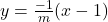 is found by solving:
![\[mx = \frac{-1}{m}(x-1)\]](https://cms.tela.org.uk/wp-content/ql-cache/quicklatex.com-735a1285f81d5e742d2c5a7fe9d8de34_l3.png "Rendered by QuickLaTeX.com")
![\[m^2x = 1 - x\]](https://cms.tela.org.uk/wp-content/ql-cache/quicklatex.com-affb3539739506161776345c8a4e52b6_l3.png "Rendered by QuickLaTeX.com")
![\[x(m^2+1) = 1\]](https://cms.tela.org.uk/wp-content/ql-cache/quicklatex.com-8e47fb6cbbab14051ae95e0d3a86dfa2_l3.png "Rendered by QuickLaTeX.com")
![\[x = \frac{1}{m^2+1}, \quad y = \frac{m}{m^2+1}.\]](https://cms.tela.org.uk/wp-content/ql-cache/quicklatex.com-0c264af824b6692aab034fdd021baf71_l3.png "Rendered by QuickLaTeX.com")
Call the point as  and the vector from to
 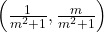 as
as  .
.
The reflection of in the line is given by  due to symmetry:
![\[\vec{p} = \left(\frac{-m^2}{m^2+1}, \frac{m}{m^2+1}\right)\]](https://cms.tela.org.uk/wp-content/ql-cache/quicklatex.com-4e63d17d9cdde3ccfee75e8db9157b54_l3.png "Rendered by QuickLaTeX.com")
![\[A + 2\vec{p} = \left(\frac{1-m^2}{1+m^2}, \frac{2m}{1+m^2}\right)\]](https://cms.tela.org.uk/wp-content/ql-cache/quicklatex.com-df8d0272f33714e7cb40fef7181485c1_l3.png "Rendered by QuickLaTeX.com")
b)
This reflection does not change distance to the origin. Thus, for the transformed point, it remains 1.
The angle between the  -axis and the line connecting the transformed point to the origin is twice that of the angle between the line and the -axis.
Let  . Then the line
  forms an angle of
  with the -axis. This is due to the likeness between
  and
and 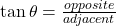 .
.
By forming a right-angled triangle whose hypotenuse is the line segment between the origin and the transformed point, the coordinates of the transformed point are:
![\[(\cos \theta, \sin \theta)\]](https://cms.tela.org.uk/wp-content/ql-cache/quicklatex.com-4ae4c3b1f5fcce10510378e8ddab67f4_l3.png "Rendered by QuickLaTeX.com")
Comparing this with the result from part A gives:
![\[\sin \theta = \frac{2t}{1+t^2}, \quad \cos \theta = \frac{1-t^2}{1+t^2}\]](https://cms.tela.org.uk/wp-content/ql-cache/quicklatex.com-f8a36404deba79311058f041ae6234cd_l3.png "Rendered by QuickLaTeX.com")
with
.
c)
From part B, the reflected point has coordinates
![\[(\cos \theta, \sin \theta),\]](https://cms.tela.org.uk/wp-content/ql-cache/quicklatex.com-03c3d2093148b8d053e3fb5602adfdd3_l3.png "Rendered by QuickLaTeX.com")
where
 is the angle in degrees between the line connecting the point to the origin and the positive -axis.
As  increases from
  to
to  , increases from
  to
to  .
.
So, the particle moves along the upper half of a circle with radius 1, following a semicircular path.
The length of this path is the circumference of a semicircle of radius 1:
![\[\text{distance} = \pi.\]](https://cms.tela.org.uk/wp-content/ql-cache/quicklatex.com-748515b43729adc333c058f26e8fd64f_l3.png "Rendered by QuickLaTeX.com")
Therefore, as  , the distance traveled by the particle approaches
  .
.