
Congratulations to Anna Poliakoff from Hitchin Girls’ School, Ishaan Agarwal from Cambourne Village College and Max Bench-Capon from The Cavendish School for successfully making significant progress to the problem!
Let  be the centre of the circle, let
 be the radius of the circle, let
 be the inradius of the triangle and let M be the midpoint of
 .
 ,
 .
(a)





fraction of the diagram shaded 
Let  be the side length of the regular tetrahedron, and let
 be its perpendicular height from the base.
(bi) Applying Pythagoras to
the right-angled triangle formed by the height, this distance
and a side of the tetrahedron,
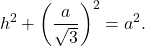
Therefore,
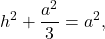


Now let  be the perpendicular distance between the
centre of the tetrahedron and its base, and let be
the radius of the circumsphere.
For a regular tetrahedron, its centre of mass is the same as the sphere. Applying Pythagoras to the
right-angled triangle formed by the sphere’s centre, the
centre of the base and a vertex of the base,
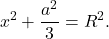
Rearranging,

The perpendicular height of the tetrahedron is also
 , since the sphere’s centre lies between the base
and the opposite vertex. Hence,

Using our previous expression for
 :



Since is not 0, we can divide both sides by:



Thus,

Since
 ,
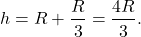
Therefore,
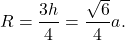
Let  be the side length of each cube.
Each cube has one face resting on a face of the tetrahedron,
with its centre aligned with the centre of that triangular
face.
The perpendicular distance from the centre of the sphere
to the triangular face is  . The furthest vertex of the
cube from the sphere’s centre is therefore a perpendicular
distance  away from the centre.
Its distance parallel to the triangular face is .
Applying Pythagoras, and noting that this furthest vertex
lies on the sphere for the largest possible cube,
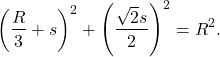
Expanding,

Multiplying through by
 and rearranging,

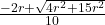
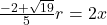
Using the quadratic formula,

Simplifying the expression under the square root,
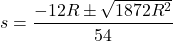
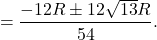
Since
is a positive length, we take the positive root: 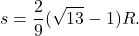
The total volume of the four cubes is

Expanding,

Therefore, the volume of the cubes is
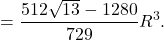
The volume of the sphere is

Hence, the fraction of the sphere’s volume occupied by
the four cubes is

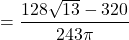

Thus, the four cubes occupy approximately
 of the volume of the sphere.
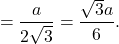
(bii) The closest points on the boundary of the triangular face
to its centre are the midpoints of its sides.
Since the triangle is equilateral, this distance, from Pythagoras is
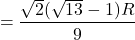
The furthest points of the square face from its centre are
its corners. Their distance from the centre is

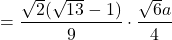
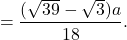
We want to show that the square fits inside the triangle.
It is therefore sufficient to show that the furthest distance the square face extends is less than the shortest distance the triangular base extends.
Since numerically,

Therefore, the square face fits entirely within the triangular face.