Congratulations to Markus Kuan from Northstowe Secondary College, Matthew Whitten from The Cavendish School, and Ishaan Agarwal from Cambourne Village College for successfully solving the problem!
Big apologies from the team for the long period of inactivity – many of us were busy over this term.
a) Since the centre of the ellipse is the origin of the circle, the value of  and
and  are both
  . The equation now becomes
We know that the ellipse passes through the point  , so if we plug in these values into the new equation, we get:


So the equation is now 

We can now plug in the values from the point  into the equation.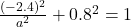
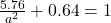


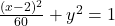
This means that the equation of the ellipse is 
b) The largest  -coordinate is
  , the largest
  -coordinate is
  . The distance between those 2 points is
  .
.
Consider a right angled triangle where the 3 points are: the centre of the ellipse, the point with the largest -coordinate, and the point with the largest -coordinate. Where the right angle is located at the centre.
The distance between the centre and the largest -coordinate is  , the distance between the centre and the largest -coordinate is
  , by Pythagoras theorem, we acquire the equation
  , since
  and
and  are both integers.
By inspection, the Pythagorean triple –  matches the equation, so the possible values of and are
  and
and  , therefore
  or
or  .
.
The centre of the ellipse is  , so
, so  and
and  .
.
So equations of the ellipse that fit the criteria includes:  and
and 
c) Notice when the parallelogram is constructed, there exists 2 lines that are parallel to the -axis, where the top of the parallelogram has the value of 1, so the largest -coordinate is  .
.
The centre of the ellipse is the centre of the parallelogram, the centre of the parallelogram is the midpoint of any diagonal of the parallelogram, take the points  and
and  , so midpoint
  , so
, so  ,
,  .
.
Recall the largest -coordinate is  , so
, so  , since , .
We now have values of , and , and the equation now becomes 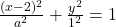
We know the largest -coordinate lies on the line passing through and  , this line has equation
  .
.
Since both the ellipse and the side of the meet at one and only one point, which is the largest -coordinate, we can solve for the value of with simultaneous equations.
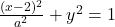

Expanding the brackets and move everything to one side we get:
Multiply all terms by  to remove the denominator to get:
To achieve a quadratic equation with as the variable, we can collect like terms to get:
Using the quadratic formula we get:![\frac{(16+20a^2)\pm\sqrt{[-(16+20a^2)]^2-4(4+a^2)(96a^2+16)}}{2(4+a^2)}](https://cms.tela.org.uk/wp-content/ql-cache/quicklatex.com-5574087475a129ecbe25f397b19308f5_l3.png "Rendered by QuickLaTeX.com")
Note that the use of discriminant is beyond the specification of GCSE Maths / Further Maths curriculum. Do not worry if you don’t understand this.
Since the ellipse only intersects the line at one point, there is only one solution to the quadratic equation, to achieve this, the value inside the square root (the discriminant) must be equal to .
A brief explanation is that when the square root term is , the  possible values of the quadratic equation will not differ as the solution is now
  , so both roots of the equation are
  , this is what we call a repeated root.
The term under the square root is:![[-(16+20a^2)]^2-4(4+a^2)(96a^2+16)](https://cms.tela.org.uk/wp-content/ql-cache/quicklatex.com-64fe8319c676794b6f7e752e6364cb63_l3.png "Rendered by QuickLaTeX.com")
![[-(16+20a^2)]^2=400a^4+640a^2+256](https://cms.tela.org.uk/wp-content/ql-cache/quicklatex.com-ecff466531be086241e3c24049e057e2_l3.png "Rendered by QuickLaTeX.com")

![\therefore [-(16+20a^2)]-4(4+a^2)(96a^2+16)=(400a^4+640a^2+256)-(384a^4+1600a^2+256)=16a^4-960a^2](https://cms.tela.org.uk/wp-content/ql-cache/quicklatex.com-eba5d6982525f87c2e377d34d2549964_l3.png "Rendered by QuickLaTeX.com")
We can now solve for  , this factors to
  , we know
  since we cannot divide by , so
Therefore equation of the biggest ellipse that fits inside the parallelogram is: