
Congratulations to Matthew Whitten from The Cavendish School and Anna Poliakoff from Hitchin Girls’ School for successfully solving the problem!
a) The equation of the line between midpoint of (1,4),(4,1) and (7,7):
Midpoint of (1,4),(4,1): (2.5,2.5)
(Gradient:  )
)
Equation of line:  (x and y coordinates are the same)
The equation of the line between midpoint of (4,1),(7,7) and (1,4):
Midpoint of (4,1),(7,7)): (5.5,4)
Both points have a y-coordinate of 4, so
Equation of line: 
The equation of the line between midpoint of (1,4),(7,7) and (4,1):
Midpoint of (1,4),(7,7)): (4,5.5)
Both points have an x-coordinate of 4, so
Equation of line: 
The point that satisfies all 3 equations is (4,4) due to and .
Therefore, the centroid is (4,4).
(It is worth noting that just two of the three lines is sufficient to find the intersection, as the third will also pass through the same point. This may be used in further parts to save time.)
b) Centroid ABC:
The equation of the line between midpoint of (3,5),(7,7) and (5,3):
Midpoint of (3,5),(7,7)): (5,6)
Both points have an x-coordinate of 5, so
Equation of line: 
The equation of the line between midpoint of (3,5),(5,3) and (7,7):
Midpoint of (3,5),(5,3)): (4,4)
(Gradient:  )
)
Equation of line: (x and y coordinates are the same)
The equation of the line between midpoint of (5,3),(7,7) and (3,5):
Midpoint of (5,3),(7,7)): (6,5)
Both points have an y-coordinate of 5, so
Equation of line: 
The point that satisfies all 3 equations is (5,5) due to and .
Therefore, the centroid of ABC is (5,5).
Centroid ADC:
The equation of the line between midpoint of (3,5),(5,3) and (2,2):
Midpoint of (3,5),(5,3)): (4,4)
(Gradient:  )
)
Equation of line: (x and y coordinates are the same)
The equation of the line between midpoint of (3,5),(2,2) and (5,3):
Midpoint of (3,5),(2,2)): (2.5,3.5)
(Gradient:  )
)
Substituting (5,3) in  :
: 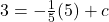 ,
,  .
.
Solving the two equations and  gives
gives  as the centroid of ADC.
Distance between and (5,5):
![\[\sqrt{(5-\frac{10}{3})^2 + (5-\frac{10}{3})^2}\]](https://cms.tela.org.uk/wp-content/ql-cache/quicklatex.com-4566e37bdf7e5c792afe10aadfc72162_l3.png "Rendered by QuickLaTeX.com")
![\[=\sqrt{\frac{50}{9}}\]](https://cms.tela.org.uk/wp-content/ql-cache/quicklatex.com-ab7703db468a06343982c8fb1c8c1ebd_l3.png "Rendered by QuickLaTeX.com")
![\[=\frac{5\sqrt{2}}{3}\]](https://cms.tela.org.uk/wp-content/ql-cache/quicklatex.com-91352a347874571b0473aabc9ca6b87e_l3.png "Rendered by QuickLaTeX.com")
c) Consider a triangle with sides  ,
,  ,
,  and centroid D, with midpoint AB
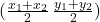 , AC
, AC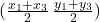 and BC
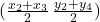 .
.
Firstly, we need to find the ratio in which a centroid splits the line of a vertex to the other side midpoint. We can do this by finding two vectors that translate the vertex to the centroid. The first vector will go from A to B and then halfway from B to C, multiplied by  (where the centroid bisects the line in the ratio
  ). The second method will go from A to C and then, multiplied by
  (where the centroid bisects the line in the ratio
  ), go from B to C and halfway along B to A.
First vector (where  is the midpoint of BC):
Second Vector (where  is the midpoint of AB):

You can write the vectors in simultaneous equations since they describe the same overall translation. We will focus on the  part of the equation.


Since this must be true for all values of  we can equate coefficients, leaving us with three simultaneous equations:


Solving these equations, we get that p and q are equal to  . Therefore, the centroid must divide the line of a vertex to its opposite midpoint in the ratio 2:1
We can now use this to find the coordinates of the centroid, based off the line from vertex to opposite midpoint (we will use the line from A to the midpoint of BC):
Simplifying, the equation of the centroid is:
(Please note that while finding equations of the three lines is completely valid, the algebra becomes very long and convoluted, so a vector method is used here, well done to those who acquired the answer using purely .)